Tooele County, Utah
Spray foam insulation in Tooele, UT
Spray foam is insulation and air barrier in a single product. It's not the right call everywhere, but in the spots where it fits, nothing else performs as well.
- Open-cell and closed-cell
- Rim joists, vaulted ceilings, irregular cavities
- Higher R-value per inch than batts or blown-in
Request a free quote
Tell us what's going on and we'll work to connect you with a licensed local insulation contractor.
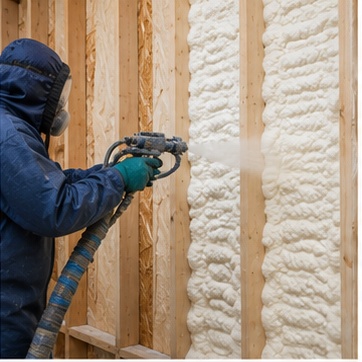
Spray foam goes on wet and expands to fill the cavity completely, sealing gaps that batts or blown-in material can't reach.
It cures within minutes to a rigid, closed surface, and a licensed applicator controls the thickness in each pass so the cavity fills evenly without gaps around wiring, plumbing or framing. That combination of insulation and air seal in one step is what makes it worth the higher cost in the right spots.
Open cell vs. closed cell
The two aren't interchangeable — each fits a different situation, and the right choice depends on where it's going and what it needs to do.
Good to know
Where spray foam makes sense
Rim joists, vaulted or cathedral ceilings with no attic access above, irregular framing, and additions where batts don't fit cleanly are the classic spray foam spots.
Where it usually isn't the right call
Large, easily accessible attic floors are almost always cheaper and just as effective with blown-in insulation. A good contractor will tell you when spray foam isn't the best use of your money.
What to expect on install day
Occupants typically need to be out of the immediate work area during application and for a short cure time afterward. The contractor will walk through timing before the crew shows up.
Common questions
What's the difference between open-cell and closed-cell spray foam?
Open-cell foam is softer, less expensive, and good for sound dampening, but it isn't a vapor barrier by itself. Closed-cell foam is denser, roughly double the R-value per inch, and acts as its own air and vapor barrier — useful in rim joists and exterior applications.
Is spray foam safe once it's cured?
Properly mixed and cured spray foam is considered safe for occupied spaces. Odor and off-gassing concerns are almost always tied to improper mixing ratios or curing conditions, which is why a good contractor is careful about application temperature and mix control.
Can spray foam be used in an existing finished wall?
Not typically — spray foam generally needs an open cavity to apply correctly. For existing finished walls, injection foam is the usual approach; see our wall insulation page for that process.
How much more does spray foam cost than fiberglass or cellulose?
It costs more per board foot than batts or blown-in material, generally by a meaningful margin. Where it's the right fit — rim joists, vaulted ceilings, irregular spaces — the air-sealing performance usually justifies it. The contractor will give you a straight comparison on the estimate.